

Table of Contents
- What Counts as an Unnecessary Filler in Skincare?
- How to Read Skincare Ingredient Labels Like a Pro
- Skincare Ingredients to Avoid if You Want Real Value
- Affordable Clean Beauty Brands That Cut Fillers, Not Results
- Cost-Per-Use Comparison: What Real Value Looks Like
- Natural vs Synthetic: A Dermatological View on What Works
- Building a Filler-Free Routine Under £70
- Frequently Asked Questions
Last Updated: September 12, 2026
What Counts as an Unnecessary Filler in Skincare?
An unnecessary filler is any ingredient that bulks up a formula, improves its texture, or extends shelf life without adding measurable benefit to your skin. This guide from virelle beauty examines which value skincare brands offer the best value for money without using unnecessary fillers.
The distinction matters because "filler" is not a formal regulatory category. The UK Cosmetic Products Enforcement Regulations govern what can legally go into a cosmetic, but they do not rank ingredients by usefulness. That judgement is yours to make, and it starts with understanding what each ingredient is actually doing.
Broadly, fillers fall into three groups:
- Bulking agents such as talc, starches, and certain silicones that add volume and slip
- Texture modifiers like cheap alcohols and gums that create a pleasant feel but evaporate or sit on the surface
- Excess preservatives and fragrance added for shelf appeal rather than skin benefit
None are inherently dangerous. The problem is cost: when a formula is mostly filler, you pay a premium for water, wax, and perfume while the actives sit in trace amounts.
The Three Functions of a Filler: Bulking, Texturing, and Preserving
To judge value, separate structurally necessary ingredients from merely cosmetic ones. The same ingredient can be functional in one formula and a filler in another; the difference is concentration and intent.
Bulking agents are the most common source of poor value. Talc adds weight and opacity, functional in a pressed powder, but a cheap way to add volume in a serum. Starches thicken and mattify without long-term benefit. Silicones like dimethicone smooth the surface; when they appear second or third after water, they usually mask a lack of actives.
Texture modifiers are trickier to spot. Cheap alcohols (denatured, SD) make a product feel light but can strip the skin barrier. Gums like xanthan or carbomer thicken water-based formulas but add no skin benefit. A long list of gums and alcohols near the top means you are paying for texture, not treatment.
Excess preservatives and fragrance are the final category. Preservatives are essential, but a formula needs a sensible system, not a cocktail. Fragrance is rarely functional and commonly triggers contact dermatitis; a "clean" product listing it high prioritises shelf appeal over skin health.
Why 'Filler-Free' Is Not a Regulatory Term
It is important to understand that no UK regulation defines a "filler." The UK Cosmetic Products Enforcement Regulations set out safety requirements, labelling rules, and restrictions on certain substances, but they do not require brands to justify the inclusion of every ingredient. This means the burden of judgement falls on you.
Brands often use "filler-free" without defining it: some mean no silicones, others no fragrance, others just a short list. Without a standard definition, the claim is meaningless unless you can read the label yourself.
How to Calculate the 'Filler Ratio' of a Product
To assess value, estimate the proportion of functional versus non-functional ingredients by looking at the first five, which typically make up the bulk of the product.
If the first five are water, glycerin, and three silicones, the formula is mostly filler: glycerin is a functional humectant, but the silicones are there for texture. Actives like niacinamide or vitamin C then appear after the preservatives, at less than 1%.
A better value formula puts actives within the first five or six ingredients. A serum listing water, niacinamide, glycerin, hyaluronic acid, and panthenol delivers more benefit per pound than one listing water, dimethicone, glycerin, dimethicone crosspolymer, and fragrance.
The Cost of Fillers: A Simple Example
Consider two £20/50ml moisturisers. The first lists water, glycerin, dimethicone, dimethicone crosspolymer, and fragrance: mostly water, silicone, and perfume. The second lists water, glycerin, niacinamide (a proven brightening, barrier-supporting active), squalane (an emollient mimicking skin lipids), and panthenol (a soothing humectant).
At the same 1% active, the second delivers it in a skin-supporting base; the first in a base of slip and scent. Cost per application is identical; value is not.
When a Filler Is Actually Functional
Not all inactive ingredients are villains. Phenoxyethanol prevents mould and bacteria; without it, a water-based product spoils within days. Xanthan gum, though a thickener, can suspend oil-soluble actives for even distribution.
Ask whether an ingredient protects the formula or pads it out. A preservative system is functional; fragrance is not. A silicone that improves spreadability of a difficult active may be functional; a silicone third in a product with no actives is not.
Understanding these categories lets you judge by the ingredient list itself, the first step to identifying which value skincare brands offer the best value for money without using unnecessary fillers.
How to Read Skincare Ingredient Labels Like a Pro
Reading an ingredient list is a skill, and the single most useful rule is this: ingredients are listed in descending order of concentration, up to the point where they make up 1% of the formula. Everything after that can appear in any order. This rule is set out in the UK Cosmetic Products Enforcement Regulations, which require ingredients to be listed in descending order of weight at the time they are added to the product.
That changes how you scan a label. If the first five are water, glycerin, and three silicones, the "active" botanicals further down are almost certainly under 1%, there for the label, not your skin.
The 1% Rule and Why It Matters
The 1% rule is your most powerful value tool. Anything listed after the first 1% can be present at any concentration, from 0.9% down to 0.001%, so a brand can list a trendy active like vitamin C or retinol near the bottom and still claim it on the front, even at a concentration too low to have any effect.
To apply it, find the ingredient likely present at around 1%, often a preservative like phenoxyethanol or a thickener like xanthan gum, typically used at 0.5-1%. Everything below that point is under 1%.
If a serum lists water, glycerin, niacinamide, phenoxyethanol, then vitamin C, the vitamin C is under 1%. Niacinamide appears before the preservative, so it is likely above 1%, the threshold for many of its proven benefits.
A Step-by-Step Checklist for Scanning Any Label
A practical approach:
- Find the first five ingredients. These define what the product mostly is. Water, glycerin, and silicones mean a texture vehicle; actives like niacinamide, hyaluronic acid, or retinol mean results are likelier.
- Identify the 1% marker. Look for preservatives (phenoxyethanol, benzyl alcohol, potassium sorbate) or thickeners (xanthan gum, carbomer). Everything after is under 1%.
- Check where the actives sit. A hero active after the 1% marker is likely too low to be effective, the most common way brands cut costs while still making claims.
- Look for fragrance and essential oils. Common irritants, rarely functional. High on the list means scent over skin health.
- Note the preservative system. None at all is a shelf-life risk; a sensible system is safe and well-formulated.
- Compare cost per millilitre, not sticker price. £10 for 30ml is £0.33 per ml; £20 for 100ml is £0.20 per ml. The larger product may be better value despite the higher sticker price.
The CosIng Database: Your Secret Weapon
The Cosmetic Ingredient Database (CosIng) lets you look up any ingredient name and see its official function. It is a genuinely useful tool for cutting through marketing language. For example, if you look up "dimethicone," you will see it is listed as a skin-conditioning agent and an emollient. That tells you it is there to smooth the skin, not to treat it. If you look up "niacinamide," you will see it is listed as a skin-conditioning agent, but its proven benefits include improving skin barrier function and reducing inflammation.
CosIng also flags ingredients restricted or banned in the UK, useful for checking whether a product contains something problematic for your skin.
What Most Guides Miss: Long Lists Are Not Automatically Bad
A long ingredient list is not automatically bad, nor a short one good. A well-formulated serum might legitimately contain twenty purposeful ingredients; a "minimal" moisturiser might contain six, four of them filler.
The key is the function of each ingredient, not the count. Twenty ingredients including proven actives, antioxidants, and a sensible preservative system likely beats six where four are water, silicone, and fragrance.
The Cost-Per-Ounce Comparison: A Mathematical Breakdown
To assess value, combine ingredient analysis with cost per use:
- Calculate cost per millilitre. A £32.41 mask for 100ml is £0.32 per ml; a £9.99 lip treatment for 20g is £0.50 per gram.
- Estimate uses. A weekly mask over three months is about 12 uses; a lip treatment used twice daily is about 180.
- Divide cost by uses. The mask is £2.70 per use; the lip treatment £0.06.
- Factor in ingredient quality. A high concentration of a proven active may justify the mask's cost per use; a lip treatment that is mostly wax and fragrance makes its low cost per use less impressive.
The cheapest product on the shelf is rarely the best value once you factor in how long it lasts and whether it works. A £68.97 LED device used 100 times costs £0.69 per session, less than a single sheet mask. But if it breaks after a month, the value disappears.
A Real-World Example: Comparing Two Serums
Consider two vitamin C serums. Serum A: £15 for 30ml, listing water, glycerin, dimethicone, fragrance, and vitamin C (£0.50 per ml). Serum B: £25 for 30ml, listing water, vitamin C, glycerin, niacinamide, and phenoxyethanol (£0.83 per ml).
At first glance Serum A looks better value. But by the 1% rule, its vitamin C appears after fragrance, typically used at under 1%, so it is likely too low to be effective. In Serum B, vitamin C appears second, likely above 1%, the threshold for its antioxidant and brightening benefits. Serum B costs more per ml but is more likely to deliver results.
This analysis separates a pro from a beginner. It is not about memorising ingredient names but understanding the label's structure and using it to judge value.
Mastering these steps lets you judge whether any product is worth your money, the foundation for identifying which skincare brands offer the best value for money without using unnecessary fillers.
Skincare Ingredients to Avoid if You Want Real Value
The skincare ingredients to avoid are not the ones with scary chemical names, but those that cost money without doing anything for your skin, or that quietly undermine the actives you paid for.
Watch for these:
- High concentrations of denatured alcohol, which can strip the skin barrier and leave it feeling tight
- Synthetic fragrance, a common trigger for sensitivity and rarely a functional ingredient
- Mineral oil and petrolatum in products marketed as "light" or "breathable", since they are occlusive and heavy
- Cheap fillers like talc in products where a functional powder would do the job better
- Excess preservatives beyond what the formula needs for a realistic shelf life
Preservatives are not the enemy. A formula without a proper preservative system grows bacteria, far worse for your skin than a small amount of phenoxyethanol. The goal is a sensible system, not zero preservatives.
Affordable Clean Beauty Brands That Cut Fillers, Not Results
Affordable clean beauty brands share one trait: they spend on actives rather than packaging and perfume. Value is not the lowest price but how much of what you pay for actually reaches your skin.
At virelle beauty, we built our selection around that principle: every product is chosen for what it does, not how it looks on a shelf.
Here is how a genuinely filler-free routine breaks down across our range:
| Product | Price | What It Does | Best For |
|---|---|---|---|
| Face Mask Shrink Pore Moisturizing | £32.41 | Collagen mask for firming and hydration | Fine lines, elasticity |
| EELHOE Bamboo Charcoal Peel-Off Mask | £19.99 | Deep pore cleansing with kaolin and witch hazel | Blackheads, T-zone oil |
| Gold Foil Snail Tear-Off Mask | £11.99 | Hydrating tear-off treatment | Dullness, dryness |
| 20-30g Lip Moisturising Treatment | £9.99 | Lip hydration and repair | Dry, chapped lips |
| Beauty Face Care Massage Jade Device | £7.62 | Relieves tension, boosts absorption | Puffiness, product uptake |
The pattern is deliberate: a collagen mask that firms, a charcoal mask that clears pores, a jade tool that boosts absorption. No filler products to pad out the basket.

For congestion, the EELHOE Bamboo Charcoal Blackhead Removal Peel-Off Mask is the workhorse, using aloe vera, witch hazel, and kaolin clay to pull oil and debris from the T-zone without cheap talc bulking out the formula.

Cost-Per-Use Comparison: What Real Value Looks Like
Cost per use is the only honest way to compare skincare value. A £9.99 lip treatment used twice daily for three months costs pennies per application; a £40 serum abandoned after a week because it irritated your skin costs far more.
Here is how the maths works in practice:
| Product | Price | Typical Uses | Cost Per Use |
|---|---|---|---|
| Lip Moisturising Treatment | £9.99 | ~90 applications | ~£0.11 |
| Gold Foil Snail Tear-Off Mask | £11.99 | ~10 treatments | ~£1.20 |
| Bamboo Charcoal Peel-Off Mask | £19.99 | ~15 treatments | ~£1.33 |
| Face Mask Shrink Pore Moisturizing | £32.41 | ~8 treatments | ~£4.05 |
| LED Facial Beauty Instrument | £68.97 | 100+ sessions | ~£0.69 |
The LED device is the clearest example. At £68.97 it looks like the biggest spend, but across a year of regular sessions it costs less per use than a single sheet mask.
Which? consumer research on beauty value makes the same point: the cheapest product on the shelf is rarely the best value once you factor in how long it lasts and whether it works.
Natural vs Synthetic: A Dermatological View on What Works
Natural does not mean effective, and synthetic does not mean harsh, the point where most clean beauty marketing quietly misleads you.
Many of the best-studied actives are synthetic or lab-derived. Retinol, niacinamide, and hyaluronic acid are produced in a lab, which is exactly why they work reliably. Meanwhile, many natural ingredients, including essential oils and botanical extracts, are among the most common causes of contact dermatitis.
The dermatological view is straightforward: judge an ingredient by its evidence, concentration, and suitability for your skin, not by whether it grew in the ground.
The cruelty-free and vegan question sits here too. A formula can be vegan and packed with filler; synthetic and still gentle. Ask what the ingredient does, not where it came from.
Building a Filler-Free Routine Under £70
A complete filler-free routine under £70 is achievable if you spend on actives and skip the padding. Here is how to cover cleansing, treatment, and hydration without a single filler product.
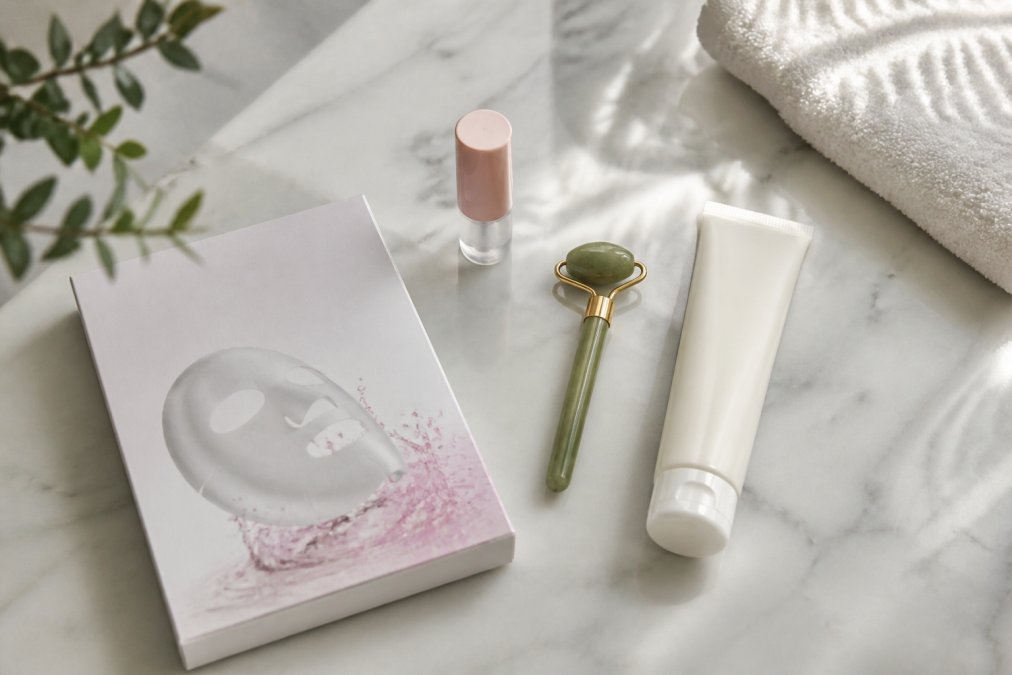
The build:
- Cleanse and treat: EELHOE Bamboo Charcoal Peel-Off Mask, £19.99, once or twice a week for congestion
- Hydrate and firm: Face Mask Shrink Pore Moisturizing, £32.41, once a week for elasticity and glow
- Maintain: Beauty Face Care Massage Jade Device, £7.62, daily to boost absorption and reduce puffiness
- Lips: 20-30g Lip Moisturising Treatment, £9.99, as needed
That comes to £70.01, and the jade device lasts indefinitely. Swap the collagen mask for the £11.99 Gold Foil Snail Tear-Off Mask and the routine drops to just under £50.

Do not buy everything at once. Start with the treatment matching your main concern, add the jade tool for absorption, and build from there. Free UK shipping on orders over £30 means a two-product start already qualifies.
Building a filler-free routine is less about finding a miracle product and more about refusing to pay for water, wax, and perfume. Most brands make that hard to judge, which is why so many shoppers end up with a shelf of products that feel nice and do nothing.
Virelle Beauty exists to remove that guesswork. We curate skincare, hair care, and styling tools chosen for visible, authentic results, with no fillers and no false promises. Every product earns its place, from the collagen Face Mask Shrink Pore Moisturizing to the LED Facial Beauty Instrument, and free UK shipping on orders over £30 makes it easy to start your ritual. Get started with virelle beauty and build a routine where every step actually works.
Frequently Asked Questions
What are considered unnecessary fillers in skincare products?
Unnecessary fillers are ingredients that add bulk, texture or shelf life without benefiting your skin. Common examples include silicones, mineral oil, synthetic fragrance, alcohol denat, and thickeners like carbomer when used purely for consistency. They are not inherently harmful, but they dilute the concentration of active ingredients, meaning you pay more for less. A filler-free formula lists actives like niacinamide, hyaluronic acid or collagen near the top of the ingredient list, not after water and glycerin.
How can I tell if a budget skincare brand is actually good value?
Look at cost per use, not just the sticker price. A £32.41 collagen mask box that delivers four treatments works out at around £8 per use. Check the ingredient list for actives in the first five ingredients, confirm the product is non-comedogenic and cruelty-free, and see whether the brand publishes full INCI lists. Transparency about formulation is the strongest signal of real value.
Are affordable clean beauty brands as effective as luxury ones?
Effectiveness depends on formulation and active concentration, not price. Many luxury brands spend heavily on packaging and marketing, which inflates the cost without improving results. Affordable clean beauty brands often use clinically studied ingredients, such as kaolin clay, aloe vera, witch hazel or collagen. What matters is whether the product suits your skin barrier, is pH balanced and avoids irritants.
How does Virelle Beauty ensure product efficacy without fillers?
Virelle Beauty curates each product for visible, tangible results rather than marketing promises. The range focuses on targeted formulas: a collagen mask for firming and hydration, a bamboo charcoal peel-off mask for pore cleansing, and a gua sha tool for lymphatic drainage and product absorption. Every item is chosen to serve a specific step in a purposeful routine, with no diluted formulas. Free UK shipping applies on orders over £30, so you can build a complete regimen without hidden costs.
Is 'clean' beauty the same as filler-free skincare?
No. Clean beauty is an unregulated marketing term that usually means the brand avoids a self-defined list of ingredients, often including parabens and sulfates. Filler-free is more specific: it means the formula prioritises active ingredients over bulking agents, emulsifiers and sensory modifiers. A product can be labelled clean but still contain fillers like silicones or synthetic fragrance. To find genuine filler-free skincare, read the full ingredient list and check whether actives appear before the preservative system.
0 comments