

Table of Contents
- Why Hair Thins After Menopause
- How to Prevent Hair Thinning with a Gentle Scalp Routine
- Best Hair Thickening Products for Women Over 50
- Menopause Hair Loss Vitamins and Dietary Changes
- How to Stimulate Hair Growth After 50
- HRT, Topical Treatments and When to See a GP
- Myths vs Facts About Menopausal Hair Loss
- Frequently Asked Questions
Last Updated: September 13, 2026
Why Hair Thins After Menopause
Hair thinning after menopause is one of the most common and least discussed symptoms of the transition, and it is driven largely by falling oestrogen rather than by age alone. If you want to know how to prevent hair thinning after menopause, the starting point is understanding that this is a hormonal process with a predictable pattern, not simply the passage of time. At virelle beauty, we hear from women who have spent years being told their shedding is "just stress" or "just ageing" when the actual driver is oestrogen deficiency.
The mechanism is well documented. Oestrogen supports the hair growth cycle by keeping follicles in the active anagen phase for longer. When levels drop, more follicles spend time in the resting phase and shed earlier than they otherwise would.

Estrogen, Follicle Miniaturization and the Growth Cycle
Oestrogen is the hormone that regulates how long each hair stays in its growing phase. When oestrogen falls, two things happen at once: the anagen phase shortens, and follicles gradually shrink through a process called follicle miniaturization. Each new hair emerges finer, shorter and less pigmented than the last.
This is why menopausal thinning rarely looks like sudden bald patches. It looks like a widening parting, a thinner crown and a ponytail that no longer feels substantial. Over time, the cumulative effect on hair density becomes visible even though no single hair loss event was dramatic.
Androgens, particularly dihydrotestosterone, become relatively more influential as oestrogen declines. In women genetically predisposed to androgenetic alopecia, this shift accelerates miniaturization at the crown and parting line.
Perimenopause vs Post-Menopause: Different Patterns, Different Fixes
Perimenopause and post-menopause produce genuinely different hair patterns, and treating them the same wastes time. During perimenopause, hormonal fluctuations are erratic. Oestrogen swings up and down rather than declining steadily, which often triggers telogen effluvium: a diffuse, all-over shed that comes in waves and can resolve on its own.
Post-menopause, the picture changes. Hormone levels settle at a lower baseline, and the loss becomes slower, more structural and more persistent. Miniaturization rather than shedding is the dominant process.
That distinction matters for treatment sequencing. A perimenopausal woman with a stress-triggered shed may respond to lifestyle modifications alone. A post-menopausal woman with established miniaturization usually needs a topical or medical intervention alongside her routine.
How to Prevent Hair Thinning with a Gentle Scalp Routine
The single most effective daily habit for preventing menopausal hair thinning is a scalp routine that protects the follicle environment instead of stressing it. Most hair loss advice focuses on the hair shaft. In practice, the scalp is where the decision gets made.
A scalp that is inflamed, congested or stripped of its natural barrier does not support healthy follicle function. Scalp sebum, the natural oil that keeps the skin barrier intact, is often disrupted by harsh cleansing. Over-washing with aggressive surfactants damages the hair cuticle and irritates the scalp at the same time.
Start with these changes:
- Switch to a sulfate-free shampoo and wash two to three times a week rather than daily
- Use lukewarm water, since hot water strips sebum and increases scalp dryness
- Apply shampoo to the scalp and let it rinse through the lengths rather than scrubbing the ends
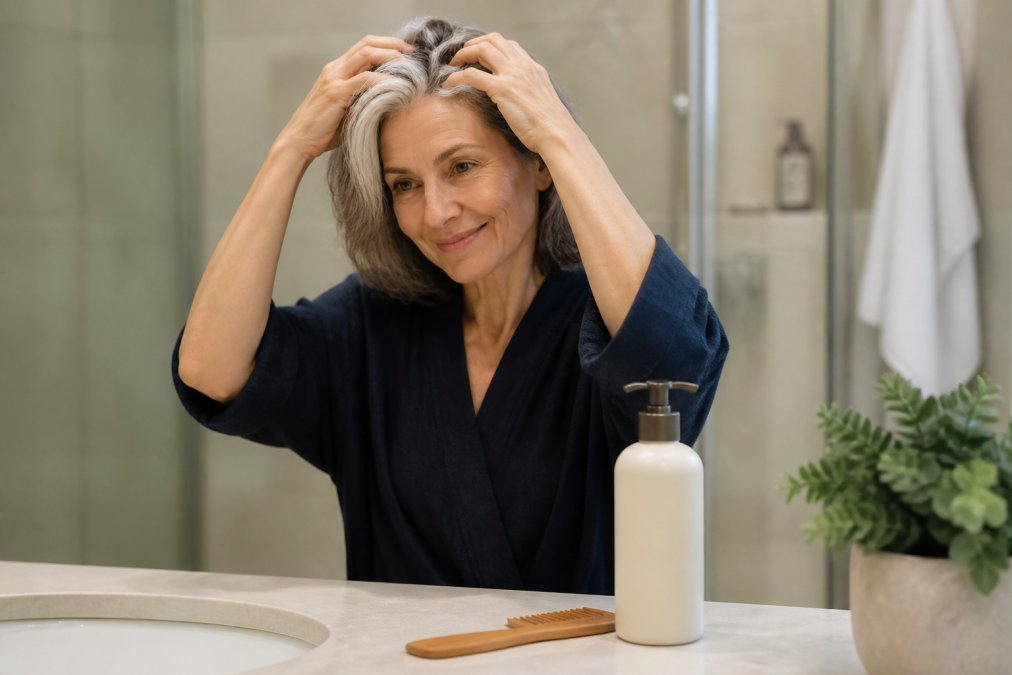
- Spend thirty seconds massaging the scalp with your fingertips to support scalp circulation
- Skip heavy conditioners at the root, and apply them mid-shaft to ends only
Washing, Drying and Styling Without Causing Breakage
Wet hair is fragile hair. The hair shaft stretches when saturated, and rough towel drying or aggressive brushing at that moment causes breakage that looks like thinning but is actually mechanical damage.
A common mistake is treating breakage and shedding as the same problem. They are not. Shedding comes from the root. Breakage happens along the shaft, and it responds to handling changes within weeks.
- Pat hair dry with a soft towel instead of rubbing
- Detangle with a wide-toothed comb while hair is damp, working from ends upward
- Air-dry where possible, and use the lowest heat setting when you do blow-dry
- Keep heat tools to a minimum and always use a heat protectant
- Avoid tight ponytails, braids and clips that pull on the same follicles daily
If you blow-dry regularly, a dryer with ionic technology reduces the static and friction that rough up the cuticle. The 1400W hairdryer with ionic technology at £39.99 is the kind of tool that makes the low-heat approach practical rather than a chore.
Best Hair Thickening Products for Women Over 50
The best hair thickening products for women over 50 are those that address the scalp and follicle rather than coating the hair shaft for temporary volume. Cosmetic thickeners have their place, but they do not change what is happening at the root.
Look for a few categories when you are choosing:
- Scalp-focused serums and lotions that deliver actives directly to the follicle
- Sulfate-free cleansers that respect the scalp barrier
- Lightweight moisturising treatments that reduce hair breakage without weighing hair down
A growth lotion applied directly to the scalp is the most straightforward addition to a daily routine. The Hair Care Growth Lotion Spray at £12.99 is a 120ml scalp spray designed for exactly this step, and it slots in after washing without adding weight to fine hair.

For a concentrated option, the Hair growth liquid at £5.99 comes in a 20ml size, which suits targeted application along a widening parting. And if your scalp feels dry or tight alongside the thinning, the EELHOE Hair Enrichment Moisturizes at £29.99 is a rosemary and mint shampoo built to reduce hair breakage while supporting healthy growth.

| Product | Price | Format | Best For |
|---|---|---|---|
| Hair Care Growth Lotion Spray | £12.99 | 120ml scalp spray | Daily all-over scalp application |
| Hair growth liquid | £5.99 | 20ml concentrated liquid | Targeted use along the parting |
| EELHOE Hair Enrichment Moisturizes | £29.99 | Rosemary mint shampoo | Dry, tight scalp with breakage |
| 1400W ionic hairdryer | £39.99 | Styling tool | Low-heat drying for fragile hair |
Menopause Hair Loss Vitamins and Dietary Changes
Nutritional deficiencies are one of the few genuinely reversible contributors to menopausal hair thinning, which is why bloodwork is worth doing before you spend money on supplements. Iron levels, zinc, vitamin D and biotin all play roles in normal hair growth, and low ferritin in particular is a common finding in women with unexplained shedding.
The NHS guidance on vitamin D is a sensible starting point for anyone considering supplementation, since vitamin D is one of the few nutrients where general supplementation is widely advised.
A practical approach to nutrition for hair:
- Eat adequate protein at every meal, since hair is largely protein
- Include iron-rich foods such as lentils, spinach and red meat alongside vitamin C
- Get zinc from seeds, nuts, eggs and whole grains
- Do not start high-dose biotin without a blood test, as it can distort thyroid test results
A common mistake is buying an expensive "hair, skin and nails" supplement and taking it indefinitely without ever checking whether a deficiency existed. Supplements correct deficiencies. They do not override genetics or hormones.
How to Stimulate Hair Growth After 50
Stimulating hair growth after 50 comes down to three levers: reduce what is suppressing the follicle, support scalp circulation, and give the follicle enough time to respond. Nothing works in a fortnight. Hair grows roughly a centimetre a month, so any honest assessment needs a three to six month window.
Scalp massage is the most underrated of these. A few minutes daily with fingertips or a soft scalp brush encourages scalp circulation without aggression. It costs nothing and pairs naturally with the scalp routine above.
Stress management is the second lever, and it is not a soft recommendation. Cortisol shifts the hair growth cycle toward shedding, so stress-induced hair loss can compound hormonal thinning. Sleep, movement and genuinely protected downtime all feed into this.
The third lever is consistency with topical treatments. A growth lotion used twice and abandoned will do nothing. Used daily for four months, it has a fair chance of making a visible difference to hair volume.
HRT, Topical Treatments and When to See a GP
Hormone replacement therapy is the intervention most often overlooked in conversations about menopausal hair, and it is worth raising with a clinician if you are already considering HRT for other menopause symptoms. Because oestrogen deficiency drives much of the follicular change, restoring oestrogen can slow the process in some women. Response varies, and HRT is prescribed for symptom management overall rather than for hair specifically.
Topical treatments sit alongside HRT rather than replacing it. Minoxidil remains the most established topical option for androgenetic alopecia and is available in the UK both over the counter and on prescription (the NHS). It requires indefinite use to maintain results.
See a GP if you notice any of the following:
- Sudden or patchy hair loss rather than gradual thinning
- Loss accompanied by fatigue, weight change or irregular periods
- Thinning alongside a scaly, itchy or painful scalp
- Hair loss that continues despite six months of consistent routine changes
Your GP can arrange blood tests for iron levels, thyroid function and other reversible causes. A referral to a dermatologist or a trichologist is reasonable if the cause remains unclear. The NHS information on hair loss sets out what is typically investigated and when referral is considered.
Myths vs Facts About Menopausal Hair Loss
Myth: washing your hair more often causes hair loss. Fact: shedding during washing is hair that had already left the growing phase. Clean scalp conditions support follicle health rather than harming it.
Myth: hair loss after menopause is permanent and untreatable. Fact: some contributors, including nutritional deficiencies and stress-induced shedding, are reversible. Miniaturization is harder to reverse but can be slowed.
Myth: a shampoo alone can regrow hair. Fact: shampoos improve the scalp environment and reduce breakage. Regrowth claims belong to treatments that reach the follicle and stay in contact with the scalp.
Myth: you should cut your hair short to make it grow back thicker. Fact: cutting changes the appearance of the ends, not the follicle. Shorter hair simply looks fuller because there is less length to thin out.
Myth: only older women lose hair after menopause. Fact: timing varies widely, and some women notice changes during perimenopause, years before their final period.
Menopausal hair thinning is a hormonal process, which means it responds to a plan rather than a single product. The women who see results are the ones who combine a gentle scalp routine, consistent topical care, honest bloodwork and a clinical conversation about HRT where appropriate. Virelle Beauty curates hair and scalp products chosen for visible results rather than filler, including scalp growth lotions, rosemary and mint shampoo, and ionic styling tools, with free UK shipping on orders over £30. Get started with virelle beauty and build a scalp routine you can actually keep to for the next six months.
Frequently Asked Questions
Can hair thinning after menopause be reversed?
Partly, and it depends on the cause. Hair lost to telogen effluvium, stress or nutritional deficiencies often regrows once the trigger is addressed. Hair lost to androgenetic alopecia, where follicles have miniaturised, rarely returns to its former density without treatment. Topical treatments and HRT can slow or partly reverse the process, but regrowth takes three to six months because the anagen phase is slow. Seeing a GP or trichologist early gives you the best chance of preserving what you have.
Do menopause hair loss vitamins actually help?
Only if you are deficient. Iron levels, zinc and biotin support the hair growth cycle, and correcting a shortfall can reduce shedding and improve hair density. If your levels are normal, supplements add little beyond expense. Ask your GP for a blood test before buying anything, particularly for ferritin, which is often low in women over 50 even when haemoglobin looks fine. Vitamin D is also worth checking, especially through winter.
Does HRT help with hair thinning during menopause?
It can, though the evidence is mixed and it is not licensed for hair loss. Oestrogen prolongs the anagen phase, so systemic HRT may slow shedding in some women. Progestogens vary: some have androgenic effects that work against you, while others are neutral or mildly helpful. Discuss the type and route with your GP, and give any change at least six months before judging whether it is making a difference to your hair.
When should I see a GP about hair loss?
Book an appointment if shedding is sudden or patchy, if you can see scalp through your hair, or if you have other symptoms such as fatigue, weight change or irregular periods. Ask for blood tests covering ferritin, thyroid function, vitamin D and zinc. A GP can also refer you to a dermatologist or trichologist if androgenetic alopecia is suspected. Early assessment matters because treatments work better before follicles miniaturise further.
0 comments