

Table of Contents
- Why Purposeful Self Care Rituals Beat Generic Routines
- Mindful Morning Routine Ideas That Set the Tone
- How to Build a Self Care Habit That Actually Sticks
- Simple Self Care Practices for Busy Days
- Evening Wind-Down Rituals for Better Sleep
- Budget-Friendly Rituals That Cost Almost Nothing
- Making Your Purposeful Daily Self Care Rituals Last
- Frequently Asked Questions
Last Updated: September 14, 2026
Why Purposeful Self Care Rituals Beat Generic Routines
A purposeful daily self care ritual is a repeated, intentional practice chosen to meet a specific physical or emotional need, rather than an activity done on autopilot. The difference matters because intention is what turns a routine into something restorative. This guide from virelle beauty covers how to build rituals that hold up on busy days.
Most people already have routines. They brush their teeth, scroll their phones, and drink coffee in the same order every morning. What they lack is a reason for each step.
A generic routine exists to get something done. A purposeful daily self care ritual exists to change how you feel. That single shift in framing is why two people can do the same ten minutes of stretching and only one of them finishes calmer.
The practical difference shows up in habit formation. When a behaviour has a clear purpose, it is easier to remember, easier to protect, and easier to resume after a disruption. NHS guidance on sleep and wellbeing makes a similar point about routine and mental health: consistency, not intensity, drives the benefit.
Below, we break down morning, midday, and evening rituals, plus a habit-stacking method that makes them stick.
Mindful Morning Routine Ideas That Set the Tone
Mindful morning routine ideas work best when they follow a fixed order: light, breath, water, then skincare. That sequence matters more than the specific activities you choose.
Light, Breath and Water Before Your Phone
The first ten minutes after waking set your nervous system's tone for the day. Reaching for a phone immediately floods your attention with other people's priorities.
Try this instead:
- Open a curtain or step outside for natural light
- Take five slow breaths, exhaling longer than you inhale
- Drink a full glass of water before any caffeine
- Only then check your phone
This is one of the simplest self care rituals to adopt because it requires no equipment and no extra time. You are reordering what you already do.
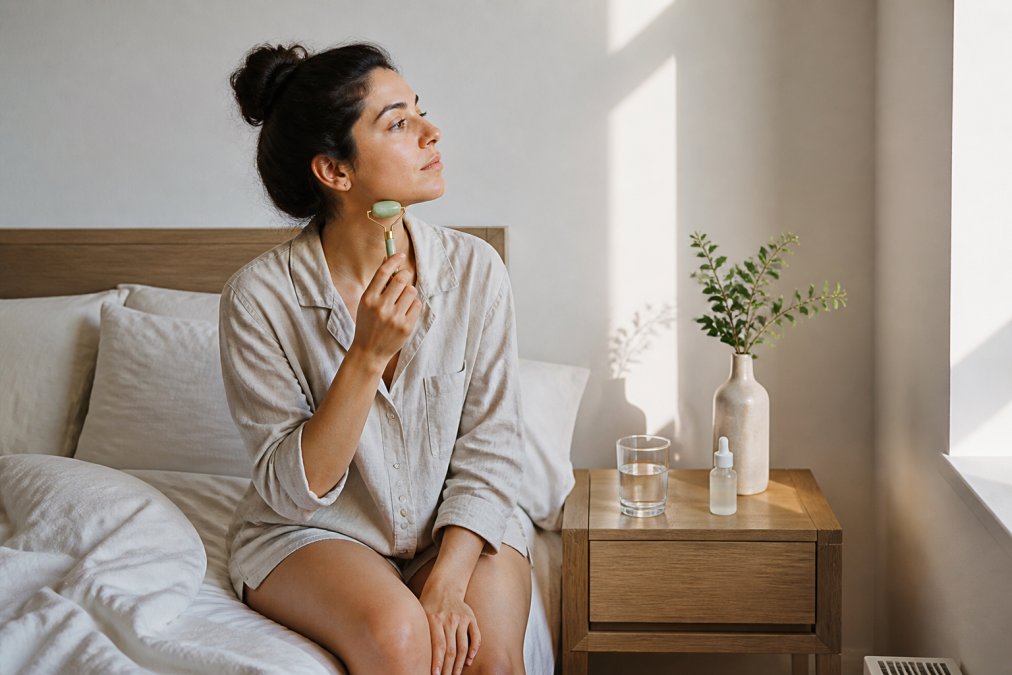
A Five-Minute Facial Ritual With Tools You Already Own
Facial massage is where a morning routine becomes tactile. A few minutes of gentle pressure reduces puffiness and gives you a moment of genuine stillness.
A gua sha board works well here. The Gua Sha Board 2PCS Massage Stone at £19.99 includes a roller as well, and chilling both in the fridge overnight makes the morning sweep noticeably more refreshing. If you prefer something smaller, the Beauty Face Care Massage Jade Device at £7.62 is an easy starting point.


Work upward and outward, always with light pressure. Two minutes per side is plenty.
How to Build a Self Care Habit That Actually Sticks
Building a self care habit that sticks comes down to three things: a fixed trigger, a small first version, and a way to recover when you miss a day. Motivation is unreliable; structure is not.
Most people fail at this stage because they start too big. A twenty-minute evening routine adopted on a Monday is abandoned by Thursday.
Habit Stacking: Attach New Rituals to Existing Ones
Habit stacking means attaching a new behaviour to something you already do without thinking. The existing habit becomes the reminder.
| Existing Habit | Stacked Ritual | Time Needed |
|---|---|---|
| Boiling the kettle | Five slow breaths | 1 minute |
| Cleansing your face | Gua sha sweep | 3 minutes |
| Getting into bed | Two pages of reading | 10 minutes |
| Taking off your shoes | Foot cream massage | 2 minutes |
Start with one row. Add a second only when the first feels automatic.
The Honey moisturizing cream foot cream leg cream at £18.99 stacks neatly onto the end of the day, since honey and avocado extracts are formulated for dry, cracked skin and the massage itself is the calming part.
Simple Self Care Practices for Busy Days
Most advice for busy days assumes you have a spare twenty minutes. You usually do not. The useful version of this section is a tiered floor: a one-minute, a five-minute, and a fifteen-minute ritual, so the day's shape decides which one you run rather than your motivation.
The mechanism is nervous-system regulation, not productivity. A slow exhale lengthens the out-breath relative to the in-breath, which is the phase of breathing most associated with the parasympathetic "rest and digest" response (the NHS). That is why a single minute of breathing can change how the next hour feels, while a rushed ten-minute routine often does not.
The One-Minute Floor
Use this when you have genuinely no time, between meetings, in a lift, waiting for the kettle.
- Extended-exhale breathing. Inhale through the nose for a count of four, exhale for a count of six to eight. Repeat for sixty seconds. The longer exhale is the active ingredient.
- Physiological sigh. Two short inhales through the nose, one long exhale through the mouth. Two or three rounds is enough to take the edge off a spike of stress.
- Hand or forearm massage. Thirty seconds per hand with whatever cream or oil is nearest. The pressure matters more than the product.
- Two minutes of daylight. Step outside or stand at an open window. Daylight exposure earlier in the day supports your body clock, which in turn supports sleep that night.
The Five-Minute Version
This is the tier most people can actually hit on a normal working day.
- One minute of extended-exhale breathing.
- Two minutes of neck and shoulder release, slow rotations, then a gentle hold on each side.
- One minute of standing stretch: reach overhead, then fold forward and let the head hang.
- One minute of nothing. No phone, no podcast, no input.
The Fifteen-Minute Version
Reserve this for the days you would otherwise skip entirely. It is the fuller ritual, not a different one.
- Five minutes of movement, a walk, a stretch sequence, or a short mobility flow.
- Five minutes of quiet with a drink you actually taste, rather than one you drink while typing.
- Five minutes of low-stakes tidying or prep, which reduces the friction of the evening ahead.
Why the Floor Beats the Ceiling
A common pattern is all-or-nothing: a full routine or nothing at all. The problem is that the "nothing" days cluster, and a cluster becomes a lapse. A floor you can always complete keeps the behaviour alive, which is what makes it resumable.
If you miss a day, run the one-minute tier the next day rather than waiting for a window to do the full version. The point of the floor is that it is always available.
Evening Wind-Down Rituals for Better Sleep
Evening wind-down rituals work by lowering stimulation gradually rather than abruptly. Sleep hygiene improves when the hour before bed looks roughly the same each night.
The most common mistake is going straight from a bright screen to bed and expecting to fall asleep. Your nervous system needs a runway.
A short sequence that covers the basics:
- Dim the lights an hour before bed
- Put the phone on charge in another room
- Complete your skincare slowly, without rushing
- Stretch your neck and shoulders for two minutes
- Read something physical until you feel sleepy
The stretching step matters more than people expect. Tension held in the neck and shoulders keeps the body alert. The Electric neck massager with far infrared thermal pain relief at £17.99 offers six pulse modes for exactly this, and using it while you read turns two separate activities into one.

If your eyes feel strained by evening, the Eye Massage Health Care Training Instrument at £49.99 uses magnetic massage to ease that specific tension.
Budget-Friendly Rituals That Cost Almost Nothing
Cost has never been the thing that makes a ritual work. What makes it work is repetition, sensory specificity, and a clear purpose, none of which require spending. This section treats free rituals as the default and paid tools as optional accelerators, which is the opposite of how most self-care content is structured.
Why Free Rituals Often Work Better
A ritual that depends on a purchase has a hidden failure mode: when the product runs out, the ritual stops. A ritual that depends on a behaviour survives the product. There is also a sensory argument, a warm shower, cold water on the face, or daylight on the skin all deliver a clear physical signal, and clear signals are what the nervous system responds to.
The Zero-Cost Core
Build your practice around these first. They are free, repeatable, and available on almost any day.
- Morning daylight. Get outside or to a window within roughly thirty minutes of waking. Natural light is the strongest signal your body clock receives, and it is free.
- Extended-exhale breathing. Four-count inhale, six-to-eight-count exhale, for one to five minutes. No equipment, no app required.
- A warm shower as a sensory reset. Treat the temperature change and the sound of the water as the point, not the washing.
- Five minutes of stretching before bed. Slow, held stretches rather than a workout. The aim is to downshift, not to train.
- One sentence of reflection. Write a single line about how the day went. One sentence is the whole commitment; more is optional.
- A short walk without headphones. Movement plus daylight plus a break from input covers three needs at once.
Where a Small Spend Genuinely Helps
Some tools do add something a free version cannot: consistent pressure, a specific temperature, or a tactile cue that makes the ritual easier to remember. If you buy, buy once and buy something that works alongside what you already own rather than replacing it.
A chilled facial tool is a good example. Cold reduces the sensation of puffiness in the morning, and the tool itself becomes the trigger, you see it, so you use it. A single reusable tool used daily will usually outperform a shelf of products used occasionally.
A Note on Subscriptions
Recurring costs are the fastest way to turn a ritual into a chore. If a practice only works when a subscription is active, it is fragile. Prefer one-off purchases, refillable basics, and tools that do not expire.
The Test for Any Purchase
Before buying anything for your routine, ask three questions:
- Does this replace something I already do, or add to it?
- Will I still use it in three months without a reminder?
- Does it make the ritual easier to start, or just more pleasant once started?
If the answer to the third question is "just more pleasant", it is a nice-to-have, not a foundation. Foundations first.
Making Your Purposeful Daily Self Care Rituals Last
Purposeful daily self care rituals last when they are small, anchored, and forgiving. Review them monthly rather than rebuilding them weekly.
Three habits separate people who keep this up from those who do not:
- They protect a minimum version for bad days
- They attach rituals to existing triggers instead of finding new slots
- They treat a missed day as a missed day, not a failed system
Consistency beats intensity every time. Ten minutes daily will do more for your wellbeing than an occasional two-hour reset.
A simple monthly review: pick one ritual that is working, one that is not, and change only the second. Mind's information on everyday wellbeing is a useful reference point for keeping expectations realistic.
Frequently Asked Questions
What is the difference between a routine and a self care ritual?
A routine is a sequence of tasks you complete, often on autopilot. A ritual is the same sequence done with attention: you notice the temperature of the water, the scent of the cream, the pressure of the tool against your skin. The steps may be identical, but the intent changes how it feels and how well it lands. That shift from doing to noticing is what turns a chore into a purposeful daily self care ritual you look forward to.
How do I stay consistent with daily self care rituals?
Anchor each ritual to something you already do without fail. Apply your facial oil straight after brushing your teeth, or roll your gua sha while the kettle boils. Keep the tool visible rather than in a drawer. Start with two minutes, not twenty. Consistency comes from low friction and a fixed trigger, not from motivation. If you miss a day, restart the next morning rather than writing off the week.
Can daily rituals help reduce stress and anxiety?
Repetitive, sensory actions give your attention somewhere specific to rest, which interrupts the loop of rumination. Slow breathing, warm water on your hands and steady pressure from a massage tool all signal safety to the body. The effect comes from regularity and from doing one thing at a time. A short ritual performed most days will do more for you than an elaborate one you manage twice a month.
What are some simple self care practices for busy days?
Pick rituals that need no extra time. Massage your hands with cream while on a call. Do sixty seconds of deep breathing before you open your inbox. Use a foot mask in the evening while watching television. Keep a jade device on your desk and use it for two minutes after lunch. Each of these fits inside a day you already have, which is why they survive a heavy week.
Most people know they should look after themselves. Far fewer build a structure that survives a bad week. At virelle beauty, we curate skincare and beauty tools chosen for visible, tangible results, with no fillers and no false promises, so each step of your regimen earns its place. Every order over £30 ships free, and our selection is built around products that make a daily ritual feel worth keeping. Browse the collection and build a routine you will still be following in six months.
0 comments