

Table of Contents
- Why Visible Hair Results Start With Daily Habits
- The Essential Hair Care Steps for Healthy Hair
- How Often to Wash Hair for Your Specific Type
- Post-Wash Drying and Detangling Without Damage
- Daily Heat Styling: Protection and Smart Alternatives
- Internal Nourishment: Diet and Scalp Health
- Your 5-Step Routine for Visible Results
- Common Mistakes That Undo Your Daily Efforts
- Frequently Asked Questions
Last Updated: September 5, 2026
Most hair care advice fails because it treats hair as a separate entity rather than a living extension of your body. Daily hair care for visible results is less about buying expensive products and more about establishing a disciplined routine that respects your scalp, your hair's structure, and your environment. At virelle beauty, we believe that consistency and technique matter more than the price tag on your shelf. The real secret is that your hair reflects your daily choices, so small, intentional actions repeated every day will always outperform an occasional intensive treatment.

Why Visible Hair Results Start With Daily Habits
The gap between healthy hair and lacklustre hair is rarely a product issue; it is a habit issue. A single deep-conditioning session on a Sunday cannot reverse the damage caused by aggressive towel drying, sleeping on wet hair, or skipping heat protection during the week. Visible improvements in hair texture, shine, and density come from the cumulative effect of daily choices that protect the hair shaft and support the scalp's natural environment.
Think of your hair as a fabric. You would not wash a delicate silk blouse with harsh detergent, wring it out, and iron it at maximum heat every day, yet many of us treat our hair with that level of disregard. A consistent regimen built on gentle handling and proper nourishment is what allows your hair to grow longer and look healthier, because you are preventing breakage and damage rather than trying to repair it after the fact. The goal is to stop the cycle of damage before it starts.

The Essential Hair Care Steps for Healthy Hair
Building a best hair care routine for healthy hair requires understanding the biological process. Your hair is dead protein, but the follicle that produces it is very much alive and depends on a healthy scalp for nutrient delivery. Each strand has a protective outer layer called the hair cuticle; when this layer is smooth and flat, light reflects off it, creating shine, and the hair retains moisture. When the cuticle is raised or damaged by harsh products, heat, or friction, hair loses moisture quickly, leading to frizz, split ends, and breakage.
Cleansing With the Right Technique
Cleansing is the foundation of any routine, yet most people wash their hair incorrectly. The essential hair care steps begin with understanding that shampoo is for your scalp, not your lengths. The scalp produces sebum, a natural oil that protects the skin, but excess sebum buildup can clog follicles and hinder healthy growth. The technique of double cleansing, where you shampoo twice, is highly effective for those who use styling products or live in urban areas where pollution settles on the hair.
The first shampoo removes surface dirt, oil, and product residue. The second lather allows the cleansing agents to actually work on the scalp, removing deeper impurities and balancing the scalp microbiome. Use your fingertips, not your nails, to massage the scalp in circular motions for at least 90 seconds. This stimulates blood flow, which supports follicle stimulation and nutrient delivery. When applying shampoo, focus exclusively on the roots and let the suds rinse through the lengths as you wash it out.
Conditioning and Moisture Retention
Conditioning is where most routines go wrong. Many people either skip it entirely, fearing heavy or greasy hair, or they apply it to the scalp, which weighs hair down and can clog pores. The correct approach is to apply conditioner exclusively to the mid-lengths and ends, the oldest and most damaged parts of the hair. This is where the hair is most porous and needs the most help retaining moisture.
Leave the conditioner on for at least two to three minutes to allow the ingredients to penetrate the hair shaft. For those with very dry, thick, or curly hair, a weekly deep conditioning treatment is non-negotiable. The difference between a conditioner that works and one that merely coats the hair lies in the ingredients. Look for products containing fatty alcohols, ceramides, and natural oils that bind to the hair and restore its lipid barrier. These ingredients help with moisture retention and improve hair elasticity, making it less prone to snapping during styling.
How Often to Wash Hair for Your Specific Type
There is no universal answer to how often to wash hair, despite what marketing campaigns suggest. The frequency depends entirely on your scalp's sebum production and your hair texture. Sebum travels down the hair shaft more slowly on curly or coily hair, which is why people with textured hair can often go longer between washes, while those with fine, straight hair may need more frequent cleansing to avoid a greasy appearance.
As a general guide, washing every two to three days works for most people with normal hair. If you have a very active lifestyle or live in a humid climate, you may need to wash more frequently to remove sweat and environmental pollutants. Conversely, if you have very dry hair or a sensitive scalp, washing once a week may be sufficient. The key is to listen to your scalp. If it feels tight, itchy, or flaky, you are either washing too often or using a shampoo that is too harsh and stripping your scalp of its natural oils, which disrupts the pH balance.
| Hair Type | Wash Frequency | Key Focus |
|---|---|---|
| Fine, Straight | Every 2 days | Lightweight, volumizing products |
| Normal | Every 2-3 days | Balanced cleansing and conditioning |
| Thick, Wavy | Every 3-4 days | Moisture retention, anti-frizz |
| Curly, Coily | Every 5-7 days | Deep hydration, gentle detangling |
Post-Wash Drying and Detangling Without Damage
The most damaging part of your hair care routine is not the washing, it is what happens immediately after. Wet hair is incredibly fragile. When hair is wet, the hydrogen bonds that give it strength are broken, making it up to 30% more elastic and prone to stretching and snapping (peer-reviewed research). Rubbing your hair vigorously with a terry cloth towel is one of the most common mistakes, causing friction that roughens the hair cuticle and leads to frizz and breakage.
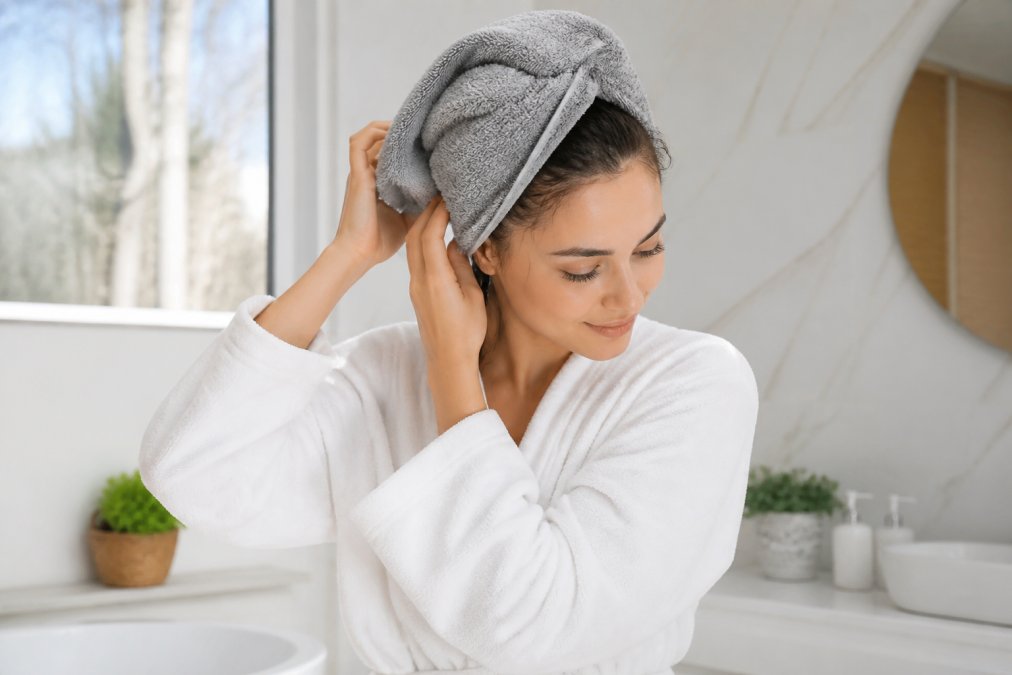
Instead of rubbing, gently squeeze excess water from your hair and wrap it in a microfiber towel or an old cotton t-shirt. Microfiber towels are significantly gentler because they reduce friction and absorb water more efficiently, cutting down drying time and minimising damage to the hair cuticle. Leave the towel on for ten to fifteen minutes to absorb the bulk of the moisture before you begin styling.
Detangling is a skill that many people rush. Never attack wet hair with a fine-tooth comb from the roots down. Start at the ends and work your way up to the roots in small sections, using a wide-tooth comb or your fingers. Applying a leave-in conditioner or a detangling spray before you comb provides slip, which allows the comb to glide through knots without pulling or snapping the strands. This gentle approach to detangling is essential for preserving hair density and preventing unnecessary hair loss.
Daily Heat Styling: Protection and Smart Alternatives
Heat styling is the fastest way to compromise your progress. Repeated exposure to high temperatures from hair dryers, straighteners, and curling wands causes the water inside the hair shaft to boil and escape, leading to brittle hair, split ends, and irreversible damage to the hair's protein structure. Thermal protection is not optional; it is a required step before any heat touches your hair.
A heat protectant spray or serum creates a barrier between the tool and your hair, raising the temperature at which your hair sustains damage. If you must use heat daily, keep the temperature as low as possible and never pass over the same section more than once. A better approach is to master air drying or to use heat-free styling methods. For example, sleeping on braids or using foam rollers can create waves and curls without any thermal damage, giving your hair a break from the daily assault of heat styling. Investing in a high-quality hairdryer with ionic technology can also make a difference, as it dries hair faster with less heat exposure, reducing the risk of heat damage.

Internal Nourishment: Diet and Scalp Health
Visible hair results are not only about what you put on your hair, but also what you put in your body. Hair is a non-essential tissue, meaning your body prioritises nutrients for vital organs before it allocates them to your hair. This is why a nutrient deficiency often shows up first as dull, thinning, or slow-growing hair. The hair you see today is the result of what you ate three to six months ago, as that is the length of the hair growth cycle (the American Academy of Dermatology).
The foundation of healthy hair is adequate protein intake, as hair is composed almost entirely of keratin, a type of protein. Iron is crucial for carrying oxygen to the hair follicles, and a deficiency is a leading cause of hair shedding (PubMed). Vitamins and minerals, including vitamin D, zinc, and B vitamins, support collagen synthesis and the overall health of the hair follicle. Rather than relying on a cocktail of supplements, focus on a balanced diet rich in eggs, leafy greens, nuts, and fatty fish. A healthy scalp is the soil in which your hair grows, and internal nourishment is how you fertilise that soil.
Your 5-Step Routine for Visible Results
Rather than overwhelming yourself with a ten-step regimen, focus on mastering five daily habits that deliver the most significant impact. This routine is designed to be sustainable and effective for daily hair care for visible results.
- Cleanse Gently: Wash your scalp with a sulfate-free shampoo using the double-cleansing technique, focusing on massage to stimulate circulation.
- Condition Strategically: Apply conditioner from mid-length to ends and leave it for a few minutes before rinsing with cool water to seal the hair cuticle.
- Dry with Care: Squeeze out excess water and wrap your hair in a microfiber towel to reduce friction and prevent breakage.
- Protect and Style: Apply a heat protectant or leave-in conditioner before any styling, and use low heat settings or air dry whenever possible.
- Nourish Internally: Support your hair growth with a protein-rich diet and stay hydrated to maintain a healthy scalp environment.
For those seeking targeted support, a product like the Hair Care Growth Lotion Spray can be integrated into your routine to provide concentrated nourishment to the scalp. This daily application is designed to complement your washing routine and support the follicle.
Common Mistakes That Undo Your Daily Efforts
Many people follow a routine diligently but see no results because of hidden mistakes that undermine their efforts. One of the most common is over-washing, which strips the hair of its natural oils and triggers the scalp to produce even more sebum to compensate, creating a vicious cycle of greasy roots and dry ends. Another error is brushing wet hair with a standard brush, which causes significant mechanical damage.
Chemical damage from over-processing, whether through frequent colouring, bleaching, or chemical straightening, compromises the hair's structural integrity, leading to hair breakage that no amount of conditioning can fully reverse. Protective styles are an excellent way to give your hair a break, but wearing them too tightly can cause traction alopecia, a form of hair loss from constant pulling on the follicle. The final mistake is inconsistency. Hair growth is a slow process, and expecting dramatic changes overnight sets you up for disappointment. Give your routine at least three months to show visible improvements in hair texture and density.
Building a routine that delivers visible results is not about perfection; it is about consistency and listening to what your hair needs. Start with the fundamentals of cleansing, conditioning, and gentle handling, and build from there. Your hair will reward you with the resilience, shine, and growth you have been chasing. At virelle beauty, we curate products designed to support this intentional approach, ensuring every step of your regimen is purposeful and effective.
The challenge is not finding another product to add to your shelf, but committing to a routine that works with your hair's biology rather than against it. virelle beauty offers a thoughtfully selected range of hair care and styling tools, free from fillers and false promises, to help you build a routine that delivers the visible, authentic results you deserve. From targeted growth treatments to ionic hairdryers that protect your hair from heat damage, every product is chosen for its effectiveness. Get started with virelle beauty and make your daily hair care ritual a purposeful step toward healthier, stronger hair.
Frequently Asked Questions
How long does it take to see results from a new daily hair care routine?
Visible changes typically take 8 to 12 weeks of consistent daily care. The hair growth cycle means new growth from the scalp takes time to show. Improvements in texture, shine, and reduced breakage often appear sooner, within 3 to 4 weeks, as the hair shaft is better moisturised and protected.
Should I wash my hair every day for better health?
For most people, washing every day strips natural oils, leading to dryness and irritation. The ideal frequency depends on your scalp and hair type. Oily scalps may need washing every other day, while dry or curly hair often thrives on a weekly wash. Over-washing can stimulate excess sebum production, creating a cycle.
What ingredients should I look for in daily hair care products?
For daily use, look for gentle, sulfate-free cleansers that maintain the scalp microbiome. Ingredients like rosemary oil are known to stimulate the scalp, while coconut oil and amino acids help prevent breakage and improve moisture retention. Avoid products with heavy silicones that cause buildup over time.
This article was written using GrandRanker
0 comments